

The strange thing about losing the career you built your life around is that people assume you’ll know what to do next.
As if twenty years of managing crises for other people prepared you for your own.
Personally, I was unprepared when I left the UN because my mother was diagnosed with an incurable form of cancer.
That’s the short version. The longer version includes being hit by a car, two surgeries, losing both parents, rebuilding during a pandemic, and now figuring out what AI changes about everything I thought I knew. Four reinventions in fifteen years. None planned. Not one.
I’m telling you this not because my story is special, but because I know what happens in the after everything your foundation disappears.
You cycle between panic and a fake sense of calm. You update your CV late at night. You tell people you’re “exploring options” while privately wondering if you have any. You feel guilty for grieving a job when there are bigger problems in the world, which, given the work most of us have done, is a thought you’ve practiced for years.
Here’s what I’ve learned after several reinventions: what you’re feeling isn’t weakness and it’s not self-pity. It’s the normal response to losing something that was never just a job.
It’s the normal response to losing something that was never just a job.
For most of you, this career was your identity. “I work for UNICEF” or “I’m with UNHCR” wasn’t a job description. It was an answer to the question of who you are.
The daily routine, the colleagues, the sense of mission, the place in the world, all of it gone seemingly overnight. And now the world expects you to bounce back with an updated LinkedIn profile and a networking plan.
I’m not going to do that to you.
This newsletter will cover the practical side of career transition, because you need it and I have a lot to say about it. CVs, interviews, networking, skills translation. But I started The Career Reset because I know personally that the practical side isn’t enough. Not for this. Not for people who built careers inside one of the most specialized professional ecosystems on earth and are now supposed to explain what they did to a hiring manager who’s never even heard of OCHA.
So alongside the job search tactics, I’ll be writing about things that most career advice ignores: wellbeing when the search drags past month three, financial reality when a tax-free salary becomes a memory, AI as a practical tool (and why it belongs on your CV today, not later), portfolio careers and entrepreneurship as real options rather than side hustles, adaptability as a practice, and what reentry to your home country feels like after a decade or more abroad.
But first, before any of that, there’s something you need to do.

This week’s exercise: The energy audit
This exercise comes from Bill Burnett and Dave Evans at Stanford’s d.school, from their Designing Your Life book (worth a look if you haven’t read it). I’m starting here because these results aren’t just for reflection. Next week, we’ll feed them into an AI prompt that maps your answers to actual roles and sectors outside the system. So do this now. It takes ten minutes, and it makes next Sunday’s issue immediately useful to you.
Step 1. Write down 8-10 activities you spent real time on in your last two years of work. Not your job title. Not your TOR. The actual things you did day to day.
Step 2. Rate each one on two dimensions. Energy: did this drain you or fuel you? Competence: were you genuinely good at it? Score both from 1 (low) to 5 (high).
Here’s what it looks like:
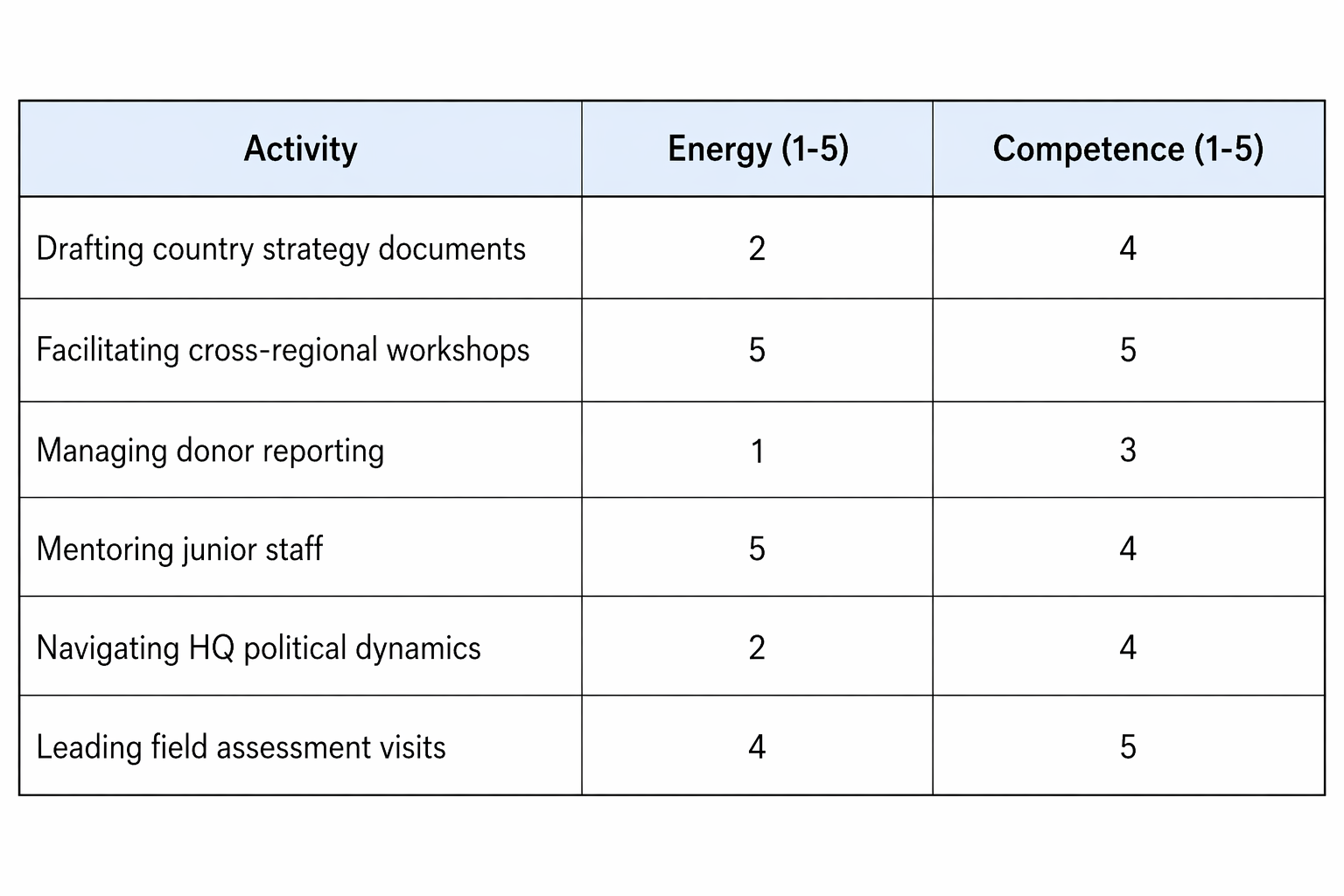
What you’ll probably notice: the activities that gave you energy don’t map neatly onto your last or current job title. The things you were best at might not be what your P-level or D-level description emphasized. That gap between what the system called your job and what actually engaged you is where your next career begins. In the specific intersection of what you’re good at and what you actually want to keep doing.
Hold onto your list. Next week, I’ll give you an AI prompt that takes your high-energy, high-competence activities and maps them to roles, sectors, and career paths you may not have considered yet.
This week’s AI prompt
You’ll need the list from the exercise above. Once you have it, try this in Claude or ChatGPT:
I’m a former [your role] with [X] years of experience in the UN/international development sector. Here are the activities from my work that I rated highest for both energy and competence: [paste your top 4-5]. I’m exploring career options outside the humanitarian sector. Based on these specific activities, not my job title, what roles, sectors, or career paths would use these same skills? Be specific. Name actual job titles, types of organizations, and industries. Don’t suggest other UN agencies or INGOs.
What you’ll get won’t be a career plan. But it will allow you to see your experience described in language the rest of the world understands. That alone is worth ten minutes.
If you’re looking at this exercise and thinking “I can’t even get an interview, why does this matter?”
Because if you lack interest it often shows more than you realize. When you apply for roles that drain you, it can come across in your cover letter, the interview, every conversation. Hiring managers might not know what’s off, but they’ll feel it and choose the person who actually wants to be there.
This is also important, because just being good at something doesn’t mean you should build the next decade around it. Years ago someone told me not to become good at things you don’t like doing. I didn’t listen. I wish I had. You’ve probably already spent years doing work that may have looked impressive on paper but left you empty inside. You have the opportunity to put an end to that.
If money is an issue, you might not be able to make that choice right now. I get it. I’ve been there. Take the job you need to take. But keep looking on the side, because doing work that drains you without a plan to move past can quickly lead to burnout.
So, just do the exercise. It’s only ten minutes. The pattern in your scores might surprise you.
Okay, that's issue one. Please leave a comment if something resonated with you or if there are things you want me to cover in future issues.
Better together,
Andrea
P.S. I know how isolating this can be. If you know someone going through it, forward this to them. Sometimes knowing you’re not the only one is the thing that helps most.